

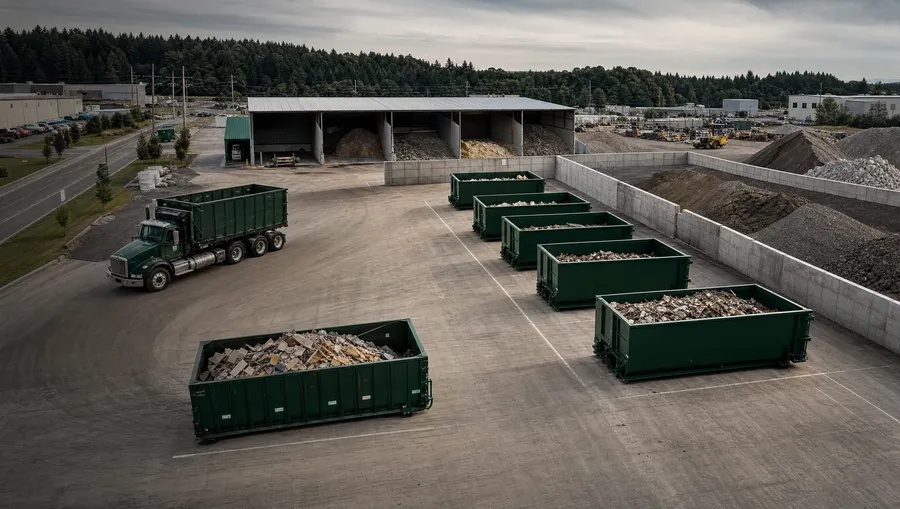
Container utilization is the share of your roll-off and bin inventory that is actively earning revenue rather than sitting idle. Raising it means shorter idle dwell, faster turns, and more billable days from the same steel, so you grow revenue without buying more containers.
If you haul roll-offs, dumpsters, or carts, your containers are expensive, finite assets. Every box parked empty on a yard or forgotten at a finished job is rent you cannot collect. The fastest margin gain for most haulers is not adding trucks or chasing new accounts, it is squeezing more paid days out of the fleet you already own.
Why utilization is the number that moves margin
A roll-off box can cost several thousand dollars and a service truck even more. When a container is on a paying job it generates rental and haul revenue. When it sits, it generates depreciation and yard congestion. The difference between an operator running 8 turns per box per month and one running 12 is enormous, and almost none of it shows up as new cost. You are simply collecting on capacity you already paid for.
The trap is that idle inventory is quiet. Nobody calls dispatch to report a box doing nothing. So utilization quietly erodes while you keep buying more steel to cover demand you could have served with what is already on the ground.
Step 1: Measure idle dwell, not just count
Most haulers know how many containers they own. Far fewer know, right now, how many are idle and for how long. Start by tracking three things per asset:
- Status: empty on yard, deployed and full, deployed and waiting for swap, in transit, or out of service.
- Idle dwell: continuous days in a non-revenue state.
- Days since last move: a blunt but powerful flag for forgotten boxes.
Recorded custody moves and status updates turn this from a clipboard guess into a reviewable history. Sort by idle dwell and last-moved time to surface the assets that need verification: the box behind a customer’s warehouse that finished three weeks ago or the unit whose pickup was never recorded. Haultro does not claim continuous GPS coverage for every container.
Step 2: Set utilization targets and a stale threshold
You cannot improve what you do not bound. Pick a target turns-per-container per month for each container class and a stale threshold, for example any deployed box that has not moved in 10 days gets reviewed. Then put both on a dashboard dispatch actually looks at. Analytics that roll up utilization by yard, by region, and by container size let you see whether the problem is one branch, one box type, or a seasonal swing.
Step 3: Forecast fill so swaps happen at the right time
Two failure modes destroy utilization. Swapping too early wastes a truck roll on a half-full box. Swapping too late leaves the customer stuck, generates a missed-pickup complaint, and ties the container up longer than it should be. Both cost turns.
Fill forecasting helps with timing. Using accepted fill readings and recorded history, Haultro projects 24-, 48-, and 72-hour values so an operator can review when a swap may be needed. Any change in missed pickups or container turns must be measured against the customer’s accepted baseline.
Step 4: Time swaps into efficient routes
Knowing a box may be ready is half the workflow. The other half is letting dispatch review whether the swap can be sequenced with nearby work instead of triggering a dedicated run. The impact on miles, cost, and turns depends on the customer’s constraints, adoption, and starting plan and is not guaranteed.
Step 5: Close the loop with billing and recovery
A finished job that never gets billed is the worst kind of idle: the container is gone and the revenue is too. Tie utilization to billing so that every deployed container has a live rental clock, and every completed pickup with proof of service flows straight into an invoice. When idle dwell and unbilled deployment are visible on the same screen, recovery becomes routine instead of a quarterly scramble. Proof of service with photos and signatures from Haultro Driver also settles disputes fast, which keeps boxes from being held hostage over a billing argument.
The revenue impact of higher turns
Run the arithmetic on your own numbers. Take a single container class, multiply the additional turns per month you can realistically gain by your average revenue per turn, then by your container count. The figure is usually larger than the cost of the next batch of boxes you were about to order, which means the highest-return move is often to raise utilization before you buy. Higher turns also relieve yard congestion, reduce the capital you have parked in steel, and let you say yes to demand spikes without a purchase order.
A short checklist to start this week
- Pull a list of every deployed container sorted by days since last move.
- Flag everything past your stale threshold and dispatch recovery or swap.
- Turn on fill forecasting for your highest-volume container class.
- Route due-for-swap boxes into existing runs instead of standalone trips.
- Confirm every completed pickup is billed and the rental clock is closed.
FAQ
What counts as good container utilization? It varies by market and container type, so benchmark against your own trend first. The goal is a steady rise in turns per container per month and a falling average idle dwell, not a single universal number.
Do I need GPS on every container? GPS and live status make idle dwell visible and cut forgotten boxes dramatically, which is where most lost utilization hides. Even partial coverage on your highest-value classes pays off quickly.
How fast can fill forecasting change my swap timing? Once enough service history is flowing, a 48 to 72 hour fill window lets dispatch schedule swaps proactively rather than reacting to a full-box call, tightening every cycle.